Always calculate based on the illuminated area rather than the overall structure.
For screens with visible seams, calculate seam loss separately and subtract it from the total area.
Seam loss:
10 × 3 × 0.002
Total Seam Area = 0.06 m²
After completing design calculations, verify key dimensions on-site using a laser distance meter.
If measured dimensions differ from the design by more than 3%, recalculate the display area.
Outdoor LED displays often include tempered glass protection.
Although the glass increases overall installation dimensions, it does not affect the effective display area because the illuminated LED surface remains unchanged.
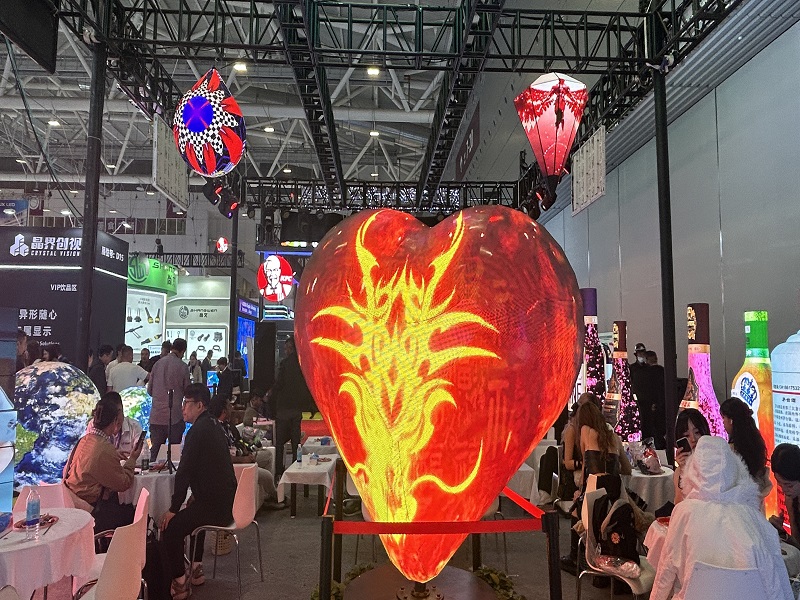
| LED Screen Type | Recommended Method | Typical Accuracy | Cost |
|---|---|---|---|
| Circular, elliptical, polygonal | Geometric decomposition | ≤2% | Low |
| Wave-shaped or artistic displays | Grid mapping or module accumulation | ≤1% | Medium |
| Spherical and complex curved displays | 3D scanning or module accumulation | ≤0.5% | High |
The most reliable way to calculate the area of an irregular LED display is to focus on the effective display area, not the external structure.
For relatively simple shapes, divide the screen into standard geometric figures and calculate each section separately. For artistic or freeform designs, use grid mapping or 3D scanning. However, whenever module data is available, module accumulation remains the most accurate and practical method, because it directly reflects the actual illuminated surface of the LED display.
In short:
If you can divide it, calculate it geometrically. If you cannot, count the modules or scan the surface. This approach consistently delivers accurate area calculations for virtually any custom LED display project.
 Hot News
Copyright © 2025 by Shenzhen Aishang Display Technology Co., Ltd - Privacy policy
 EN
EN